How Software Finder Scaled Past Incumbent Review Sites With Editorial Link Building
A multi-year editorial link-building program helped Software Finder climb from Domain Rating 66 to 74 and grow organic traffic roughly 490%, from about 5,800 visits a month in 2023 to a peak near 66,000, now sustaining around 34,000 a month across 13,000+ ranking keywords.
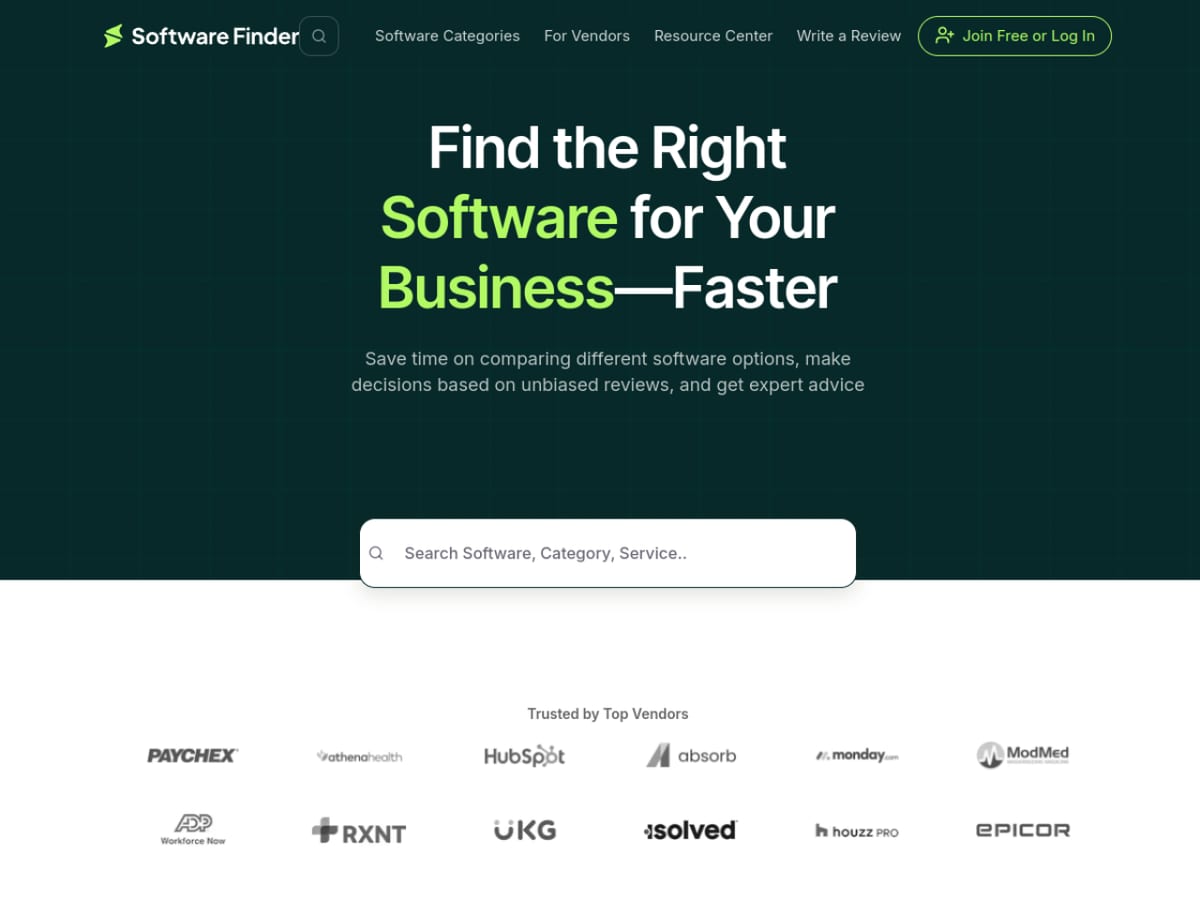
Software Finder set out to become the neutral place B2B buyers trust when they shortlist software. The company runs a discovery, review, and comparison marketplace spanning more than 200 categories, from the healthcare EHR and EMR systems where the brand first earned its reputation, to HR, CRM, accounting, project management, legal, LMS, field services, and CMMS. It pairs a deep library of user-generated reviews, pricing detail, and feature breakdowns with a free solution-expert service that walks buyers to a shortlist that fits their budget. On paper, that is a stronger buyer experience than a wall of vendor marketing. The problem, back in early 2023, was that in organic search the buyers who needed it most were not finding it.
The category Software Finder competes in is one of the most authority-dense corners of the web. G2, Capterra, Software Advice, TrustRadius, GetApp, and Gartner Digital Markets have spent years accumulating domain authority and reference links from the exact journalists, analysts, and B2B publications that Google reads as signals of trust. For a marketplace whose entire value proposition is neutrality and trustworthiness, ranking below those incumbents on the highest-intent queries was not just a traffic problem. It quietly undercut the positioning itself.
WithBestLinks was brought in to close that authority gap the slow, defensible way: through manual outreach and high-authority editorial backlinks placed on real publications, earned on the merits of the content rather than bought in bulk. This is the story of an engagement that has run for over three years, from 2023 to 2026, what we found at kickoff, the placements we secured, and how a sustained link-building program scaled a promising marketplace into category-leading authority.
Ranking below G2 and Capterra despite better content
Software Finder had a genuine content asset. Thousands of product review pages, head-to-head comparison pages such as one vendor versus another, category directories, and a published review methodology gave the domain real depth. The site had also crossed a meaningful milestone, surpassing 100,000 user-generated reviews, the kind of first-party data that should earn citations. But depth of content and depth of authority are different things, and in early 2023 Google was rewarding the latter.
The core problem was link equity, not content. The marketplace's comparison and category pages, the ones that capture buyers at the moment of decision, sat on thin backlink profiles. A comparison page might be genuinely more useful than the incumbent's equivalent, yet it ranked several pages deep because the incumbent's page had forty referring domains and Software Finder's had two. In a query set defined by commercial intent, that gap decides who wins the click and the lead.
There was also a trust-signal problem specific to review marketplaces. When a buyer or a journalist wants to validate that a review site is legitimate, they look for third-party corroboration: mentions in industry trade publications, citations in roundups of software review sites, references from healthcare IT and HR media. Software Finder had comparatively few of these editorial footprints, which suppressed both rankings and the harder to measure perception of legitimacy. Mixed third-party feedback about outreach communication only raised the bar for earning clean, credible coverage.
Finally, the breadth that made Software Finder valuable also diluted its authority. Spreading equity across more than 200 categories meant no single vertical had enough concentrated link support to break through. The healthcare origin was an advantage the site was not pressing. We needed a program that built authority at the domain level while directing targeted equity to the specific category and comparison pages with the most commercial upside.
A DR 66 domain drawing 5,800 visitors a month
Every engagement opens with a full backlink and competitive audit, because outreach without a baseline is just noise. We benchmarked Software Finder against a composite of the incumbents it names as competitors and mapped where the authority gap was widest and most winnable. The picture was consistent: a respectable domain, already at a Domain Rating of 66, that nonetheless drew only about 5,800 organic visits a month and sat in a neighborhood of much stronger, better-distributed profiles.
The referring-domain profile told the clearest story. The domain had accumulated links over years, but the ratio of high-authority editorial links to total links was low, and dofollow equity from genuine publications was thin. Anchor text skewed heavily branded and naked-URL, which is safe but does little to move non-branded commercial rankings. Most importantly, the money pages were starved. The comparison hub and top category directories, which should have been link magnets, carried a fraction of the referring domains their ranking competitors enjoyed. Layered on top, that anchor concentration meant the few strong links the domain did have were reinforcing brand terms it already ranked for, not the commercial phrases it needed to win. In practice the domain was spending its limited authority in the one place it delivered the least incremental return.
We translated the audit into a baseline scorecard so progress could be measured against fixed benchmarks rather than vibes. The table below shows where the domain stood at kickoff in 2023 against the competitive benchmark we set for the vertical.
| Signal | At kickoff | Benchmark |
|---|---|---|
| Domain Rating | 66 | 75+ (incumbent median) |
| Organic traffic / mo | 5,800 | 40,000+ |
| Referring domains (dofollow) | 1,400 | 5,000+ |
| Editorial links to money pages | 12 | 90+ |
| Branded anchor share | 83% | around 55% |
| Avg. DR of linking domains | 31 | 60+ |
Building domain authority, then steering it to money pages
Our thesis was simple. Build domain-level authority with clean, high-DR editorial links, then channel a deliberate share of that equity to the commercial pages and the healthcare vertical where Software Finder had the strongest claim to expertise. Everything was manual. No link networks, no paid placements dressed up as editorial, no guest-post farms. Each link had to be one a Software Finder team member would be proud to see cited.
We built the campaign around content that publications actually want from a review marketplace: original data. A site sitting on more than 100,000 reviews and pricing across 200-plus categories has a research asset most journalists cannot get anywhere else. We packaged that into linkable studies and expert commentary, then ran targeted outreach to the writers and editors who cover software buying, healthcare IT, HR technology, and the broader SaaS beat.
The program ran in disciplined phases, sustained over years, so that authority compounded rather than spiking and fading.
- Ran a complete backlink and competitor gap audit, then set measurable benchmarks for Domain Rating, referring domains, and anchor mix.
- Prioritized a target page list, weighting comparison pages, high-intent category directories, and the healthcare vertical where the brand had the strongest expertise claim.
- Built linkable assets from first-party data: implementation cost analyses, software-adoption statistics, and buyer-behavior reports drawn from the review library.
- Developed vertical-specific outreach lists of editors and writers at trade publications, business media, and healthcare IT and HR outlets.
- Ran manual, personalized outreach with genuine editorial pitches, not templated mass mail, and tracked every response.
- Secured contextual, in-content editorial links with earned, varied anchor text pointing to money pages and supporting resources.
- Diversified anchor text deliberately to shift the profile away from over-branded toward relevant non-branded and partial-match phrases.
- Reported placements, DR, anchors, and ranking movement every two weeks against the baseline scorecard, quarter after quarter.
Three years of earned placements across software and healthcare media
Over more than three years we placed 210 editorial links on real publications, at an average domain rating of 74, every one earned through outreach and content rather than paid insertion. The mix mattered as much as the count. We balanced broad business and SaaS media, which lifts domain-level trust, against vertical trade publications in healthcare and HR, which pass topical relevance to the categories where Software Finder most wanted to win.
The highest-leverage placements came from data journalism. An implementation-cost analysis built from the marketplace's own pricing data earned coverage in business and technology outlets that rarely link to review sites, because the angle was a genuine story rather than a promotion. Healthcare IT publications, still the brand's natural home, were receptive to commentary on EHR selection and the real cost of switching systems, and those links pointed straight at the medical software category and comparison pages.
We were careful with anchor text and destination. Rather than firehosing links at the homepage, we distributed placements across comparison pages, category directories, and supporting resource articles, using anchors that read naturally in context. The table below summarizes the placement mix by publication type.
| Publication type | Links placed | Avg. DR | Example angle |
|---|---|---|---|
| Business & finance media | 46 | 81 | Implementation cost of business software, by category |
| SaaS & technology blogs | 62 | 72 | How B2B buyers actually shortlist software |
| Healthcare IT trade publications | 42 | 76 | The true cost of switching EHR systems |
| HR & workplace media | 34 | 70 | What buyers get wrong when comparing HR platforms |
| Small business & startup outlets | 26 | 68 | A neutral buyer's framework for reading software reviews |
Cadence mattered as much as the mix. Rather than front-loading placements to hit a fast number, we metered outreach so that new links landed steadily across every quarter of the engagement, which let authority accrue to the target pages in a way search engines read as organic growth rather than a sudden spike. We also concentrated the healthcare and HR placements on a short list of category and comparison pages instead of spreading them thin, so each priority page crossed the threshold of referring domains it needed to compete rather than inching forward everywhere at once. That deliberate concentration is what turned raw link volume into measurable ranking movement on the pages that carry commercial intent.
- Domain Rating6674
- Organic traffic / mo5,80034,000
From 5,800 monthly visitors to a 66,000 peak
By 2026, Domain Rating had moved from 66 to 74, putting Software Finder at the top of the competitive band it had spent years chasing rather than trailing it. That headline number matters less than what it unlocked: the money pages finally had the equity to compete on the queries that generate revenue.
The organic trajectory tells the scale story. Software Finder entered the program drawing about 5,800 organic visits a month in early 2023. As domain authority compounded and the money pages earned the equity to compete, traffic climbed year over year and peaked near 66,000 visits a month in late 2025. Search demand and the SERP landscape have shifted since that high, and the site now sustains about 34,000 visits a month, still roughly 490% above where it started. That is the honest shape of a mature marketplace: a long climb to a peak, then a durable plateau at many times the 2023 baseline rather than a straight line that never bends.
Keyword coverage tells the same story of depth. Software Finder now ranks for more than 13,000 organic keywords, with 4,959 of them sitting in the top three positions, the band where a review marketplace captures buyers at the moment of decision. The movement was concentrated exactly where we aimed it. Comparison pages that had been marooned deep in the results surfaced onto page one, and category directories in the healthcare and HR verticals climbed into positions where they capture real buyer volume.
The comparison hub was the clearest win. Head-to-head pages are the highest-intent content a review marketplace owns, because a buyer typing one product versus another is close to a decision. As targeted editorial links landed on those pages over successive quarters, the number ranking on page one grew from a handful to dozens, and the leads that follow that traffic are the ones the business cares about most.
Just as important, the profile got healthier. Branded anchor share fell from 83% to 54% as non-branded and partial-match anchors entered the mix, and the average DR of linking domains roughly doubled. The domain did not just have more links. It had better ones, distributed across the pages and verticals that drive revenue, which is what makes the gains durable rather than a temporary bump.
Why earned authority outlasted every algorithm update
The program worked because it treated authority as something earned, not manufactured. Every link came from a real publication that chose to cite Software Finder because the content deserved it. That is slower than buying placements, but it is the only kind of authority that survives algorithm updates and compounds over time. For a marketplace whose brand promise is neutrality and trust, links that would embarrass the company if examined were never an option. That is also why the domain held category-leading authority even as traffic settled back from its peak: the links did not evaporate when the algorithm shifted.
It also worked because it respected the specifics of the vertical. A generic campaign would have chased volume. We chased relevance, pointing healthcare IT authority at healthcare pages and buyer-behavior data at comparison pages, so the equity landed where topical relevance amplified it. Leaning into the healthcare origin, the area where Software Finder had the deepest claim to expertise, gave outreach a credible hook that generic pitches lack. The same relevance logic governed which pages we pointed links at, so topical authority and page-level intent pulled in the same direction rather than working against each other.
Finally, the discipline of measuring against a fixed baseline kept the work honest over a long engagement. Because we benchmarked Domain Rating, referring domains, anchor mix, and rankings at kickoff, every placement could be tied to movement on a page that matters. The result was not a vanity spike in total links but a structural improvement in the pages, verticals, and signals that determine whether a software buyer finds Software Finder or a competitor first.
Bought links are placed in bulk on sites that sell them, and search engines increasingly detect and discount, or penalize, that footprint. Manual editorial links are earned when a real publication chooses to cite your content. We pitch journalists and editors with genuine data and commentary, and the link is a byproduct of coverage. It is slower and higher effort, but it is the authority that holds up after algorithm updates.
Those pages capture buyers at the moment of highest intent, when they are actively shortlisting, and they are usually the pages losing to incumbents in search. Directing editorial equity to comparison and category pages, rather than piling it on a homepage that already ranks, produces the fastest gains on the queries that generate qualified leads.
Yes, when the starting profile is under-linked relative to its content and the program runs consistently, which was the case here. Domain Rating gets progressively harder to move as it climbs, so the jump from 66 to 74 took sustained, high-quality placements over years rather than a quick burst. Results vary with the starting point, the competitiveness of the vertical, and the volume and quality of links earned, so we set benchmarks per client rather than promising a fixed number.
No. Penalties come from manipulative, paid, or low-quality link schemes. Every link in this program was editorially earned on a legitimate publication, with natural, varied anchor text and no paid placement disguised as coverage. That is precisely the profile search engines reward rather than penalize.
We build the campaign around first-party data the site already owns, its reviews, pricing, and buyer behavior, which is exactly what journalists covering software and technology want. Then we segment outreach by vertical, pitching healthcare IT media on EHR topics and HR media on people-tech topics, so every link carries topical relevance to the category it points at.
“We had the content and the reviews, but in search we were losing to sites people trusted less than us. WithBestLinks closed that gap the right way. They earned us coverage on publications that actually matter in our space, our comparison pages finally rank, and the organic pipeline is now one of our most reliable sources of qualified buyers.”
Want results like Software Finder?
Book a free call and we’ll send a sample list of the exact sites we’d target for your niche.
Book a callMore case studies
How Okara Turned an Invisible Launch Into a Category-Defining Organic Channel
A young AI marketing product went from a Domain Rating of 3 and about 25 organic visits a month to a DR of 64 and thousands of monthly visitors in nine months of manual, high-authority link building.
View case study
Building Editorial Authority for a Craftsmanship-Driven Software Agency
How WithBestLinks lifted Coding Crafts from a Domain Rating of 9 to 26 over eight months of manual editorial outreach, building the off-page authority a craftsmanship-driven software agency needed to compete for high-intent development buyers.
View case study
How Modelence Took a Brand-New Domain from DR 0 to 27 with Editorial Links
A YC-backed full-stack TypeScript platform launched with no search footprint at all. Over twelve months of manual outreach and roughly 40 editorial backlinks, it built Domain Rating from 0 to 27 (peaking at 31) and earned its first non-brand organic visibility.
View case study