How Okara Turned an Invisible Launch Into a Category-Defining Organic Channel
A young AI marketing product went from a Domain Rating of 3 and about 25 organic visits a month to a DR of 64 and thousands of monthly visitors in nine months of manual, high-authority link building.
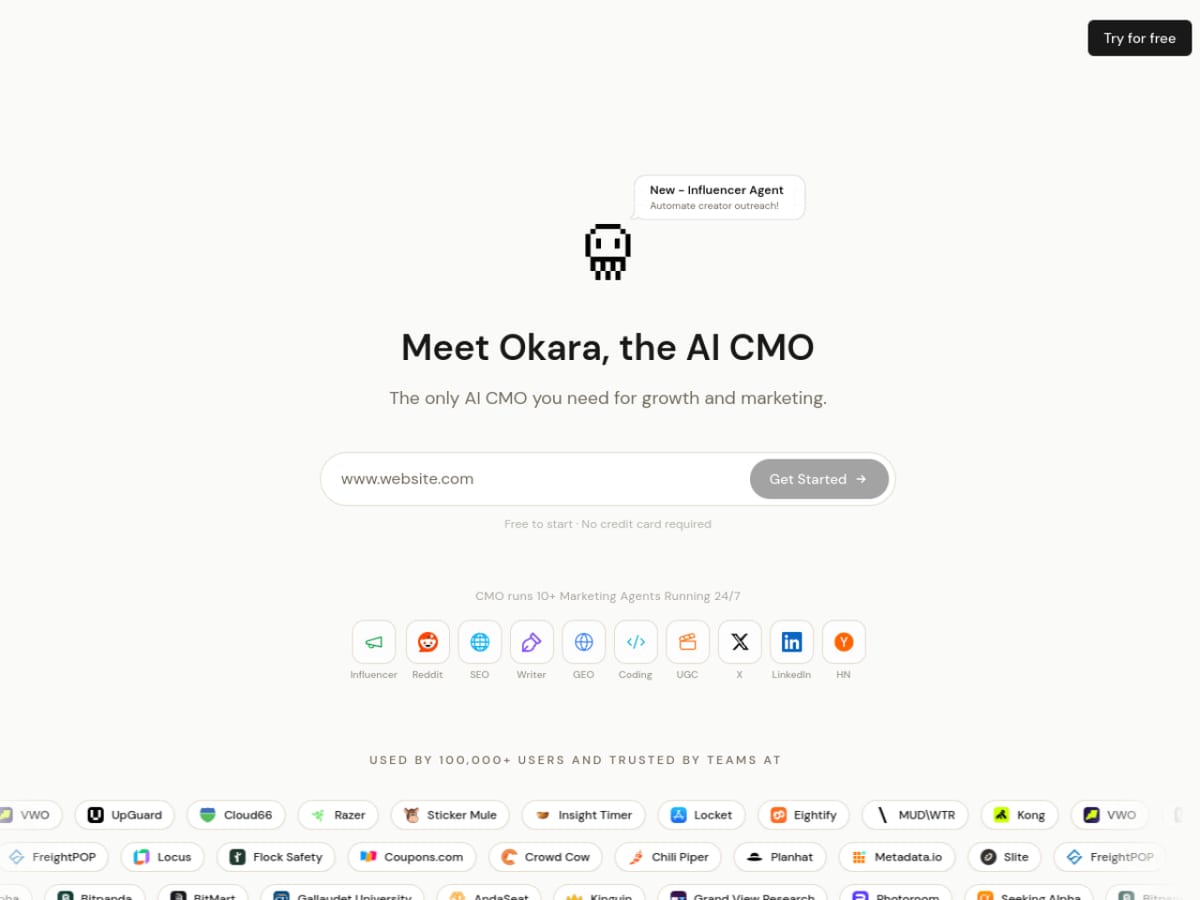
Okara launched its flagship AI CMO product in 2025 with an unusually bold claim: that a team of autonomous marketing agents could replace a marketing hire, an SEO agency, and a roster of freelancers for ninety-nine dollars a month. A founder enters a website URL, and Okara reads the public site, builds a product profile, drafts strategy documents, audits technical SEO, and then runs agents in the background across SEO, GEO, Reddit, X, LinkedIn, articles, Hacker News, UGC video, and influencer outreach. Everything the agents produce lands in an Agents Feed that the user reviews and approves before anything is published. The positioning is democratization: great marketing should be the default, not a privilege reserved for teams that can afford a five-figure monthly budget.
That mission is exactly why the company faced a hard problem of its own. Okara sells distribution to solo founders, indie hackers, and bootstrapped startups. Those buyers are skeptical by nature and allergic to hype. They research tools obsessively before they part with even a modest subscription, and they trust independent editorial coverage far more than any vendor landing page. A product that promises to solve marketing has to look, in search results and in the press, like it has already solved its own. When Okara came to WithBestLinks, the site had strong on-page content and a compelling narrative, but almost no third-party authority behind it. In a martech category crowded with well-funded incumbents, that gap was the single biggest thing standing between the product and its addressable market.
WithBestLinks is a done-for-you editorial link-building agency. We do not buy links, spin content, or chase directories. We earn placements the manual way, through relationship-driven outreach to editors and writers at publications that real buyers actually read, pairing each placement with an angle that is genuinely useful to that outlet's audience. Over nine months we set out to give Okara the off-site authority its on-site story deserved. This is how that engagement ran, what we found at the starting line, and what the numbers looked like when we finished.
Competing in martech with no authority signal
The AI marketing category is one of the most contested corners of software search. Established names in AI writing and GTM tooling, along with entrenched SEO platforms, have spent years accumulating referring domains and topical authority. For a product that launched in 2025, competing on the terms that matter meant competing against domains with a decade head start. Search engines treat editorial links as votes of confidence, and Okara had barely any. Ranking for a phrase like AI CMO, or for high-intent comparison and alternatives queries, was not going to happen on content quality alone. The domain simply lacked the authority signal that pushes good pages onto the first page.
There was a second layer to the problem that is specific to this vertical. Okara's buyers do not just search Google. They ask AI assistants for recommendations, they read Hacker News threads, they scan Reddit and founder communities, and they weigh which tools get cited in independent roundups. GEO, the practice of earning visibility inside AI-generated answers, depends heavily on being mentioned and linked across credible, crawlable sources. A brand that is invisible in editorial coverage tends to be invisible in AI answers too, because the models draw from the same corpus of trusted pages. Okara needed authority that would compound across both classic search and the newer answer surfaces at once.
Third, there was a credibility mismatch that outreach had to handle carefully. Okara's marketing site carries strong claims, including a stated count of more than one hundred thousand users and recognizable customer logos such as Kong, Razer, VWO, and Sticker Mule. Those are persuasive on the company's own pages, but they are company-stated claims, and editors are rightly cautious about repeating figures they cannot independently verify. Our job was to build authority through angles that stood on their own merits, teaching, data, and genuine founder insight, rather than leaning on unverifiable numbers. That constraint actually sharpened the strategy: it forced every placement to earn its link by being useful, not by being loud.
Finally, timing mattered. A launch window is a narrow opportunity. Coverage earned in the first two quarters after launch does disproportionate work, because it establishes the reference points that later coverage and AI answers cite back to. We needed to move fast without ever sacrificing placement quality, which is the tension that defines every good link campaign in a competitive vertical. It is also the tension that most agencies resolve in the wrong direction, buying speed with low-quality links that age badly, so we set the opposite rule from day one: velocity only where it did not cost us relevance.
Starting from a Domain Rating of 3
Every WithBestLinks engagement opens with a full off-site audit, because you cannot build authority intelligently without knowing exactly where the domain sits today. For Okara we pulled backlink profiles, referring domain counts, anchor distribution, and ranking data, then benchmarked each signal against the median for established players in the AI marketing category. The picture was consistent with a strong product on a young domain: excellent content, healthy technical foundations from the team's own SEO work, and very little external validation. The product was ready to compete. The domain was not yet allowed to.
The Domain Rating sat at 3, which is typical for a site in its first months but far below the range where competitive terms become reachable. Referring domains were sparse, and most were low-relevance mentions rather than earned editorial links. Organic traffic reflected the same story, hovering around twenty-five visits a month, essentially a rounding error against the category. The anchor profile was dominated by branded and naked-URL anchors, which is healthy in the sense that it looked natural, but it meant almost no topical anchor equity was flowing to the pages that needed to rank. The audit gave us a clear, unglamorous baseline and a precise set of gaps to close.
The table below summarizes where the domain stood at kickoff against the benchmark we set for a credible challenger in this space. The benchmark is not the category leader; it is the threshold at which a well-optimized page can realistically compete on the first page for mid and high-intent terms.
| Signal | At kickoff | Benchmark |
|---|---|---|
| Domain Rating | 3 | 40 to 50 |
| Monthly organic traffic | About 25 | Thousands |
| Ranking keywords | Near zero | A focused, high-intent set |
| Editorial links from DR 50+ sites | A handful | 50+ |
| AI-answer citations | Rare | Consistent |
Relevance over volume on a young domain
We designed the campaign around a single principle: relevance compounds faster than raw volume. It is tempting on a young domain to chase the highest Domain Rating link available, but a high-authority link from an unrelated site moves the needle far less than a topically aligned placement in a publication Okara's buyers actually read. So we built a target list weighted toward martech and SaaS trade publications, founder and startup media, developer-leaning outlets that overlap with the Hacker News and indie hacker audience, and credible SEO and growth blogs. Every target had to clear two tests: does its audience include Okara's buyers, and does its editorial standard mean a link there is genuinely earned.
From there we mapped each target to an angle that served both the outlet and Okara's ranking priorities. The AI CMO concept is inherently newsworthy in a marketing-media context, and the founder-cost narrative, replacing a roughly fourteen-thousand-dollar-a-month function for ninety-nine dollars, is a genuinely interesting data point for any story about the economics of lean startups. We never pitched the product as the story. We pitched useful ideas, then placed Okara inside them as the natural, credible example.
The concrete workstream broke down into the following steps, run in parallel and sequenced so that early foundational links raised the domain's floor before we pursued the most competitive placements.
- Off-site audit and competitor backlink gap analysis to identify which referring domains our competitors had that Okara did not.
- Priority page mapping: choosing the specific URLs, category pages, comparison pages, and top-of-funnel guides, that each link should strengthen.
- Angle development: building four repeatable editorial hooks around AI marketing economics, GEO and AI-search visibility, founder distribution tactics, and technical SEO.
- Manual outreach: personalized, one-to-one pitches to named editors and writers, with no templated blasts and no paid placements.
- Digital PR data hooks: packaging original founder-marketing cost analysis into a format writers could cite and link.
- Ongoing anchor and velocity management: keeping link growth natural and steering topical anchors toward priority pages.
- Monthly reporting against the baseline audit, tied to Google Search Console and analytics movement.
The publications we earned Okara links on
Over the nine months we placed 47 editorial links through manual outreach. The pace was deliberately front-loaded but never rushed: foundational placements in trade and startup media in the first months lifted the domain's authority floor, which in turn made the higher-authority outlets in the later months more receptive, because editors could see the brand was already being covered credibly elsewhere. Not a single link was bought or exchanged. Every placement came from a writer who agreed the angle was worth publishing, which is the only kind of link that keeps its value once the campaign ends.
The mix mattered as much as the count. We spread placements across publication types so the profile looked like what it was, a genuinely useful product earning coverage from multiple independent corners, rather than a coordinated campaign. Developer and technical outlets did double duty by feeding the GEO objective, since those pages are heavily crawled and frequently cited in AI answers about tooling. Founder and startup media carried the cost-economics angle that resonated most with Okara's core buyer. The table below breaks down the placements by publication type, the volume in each bucket, the average Domain Rating of the outlets we secured, and the representative angle we led with.
| Publication type | Links placed | Avg. DR | Example angle |
|---|---|---|---|
| SaaS and martech trade publications | 13 | 61 | The economics of an AI CMO vs. a marketing hire |
| Startup and founder media | 11 | 58 | How bootstrapped teams win on distribution |
| Developer and technical outlets | 9 | 67 | GEO: getting cited in AI-generated answers |
| SEO and growth blogs | 8 | 54 | Technical SEO checklist for young SaaS domains |
| Industry roundups and comparisons | 6 | 49 | Where autonomous marketing tools fit in 2026 |
Each angle was tied back to a priority page. The economics stories linked to Okara's core AI CMO category page. The GEO and technical pieces pointed at the relevant how-to guides and explainers, which both strengthened those specific URLs and reinforced Okara's topical authority on the exact subjects it wants to be known for. By keeping anchors varied and contextual, we grew the topical anchor share from single digits toward the healthy range without ever tipping into the over-optimized patterns that trigger scrutiny.
- Domain Rating364
- Monthly organic trafficAbout 255,807
From 25 visits a month to thousands
Nine months in, the compounding effect was unmistakable. Domain Rating climbed from 3 to 64, crossing the threshold where Okara's well-optimized pages could finally compete on merit. That is an enormous move for a domain that started with almost no external validation, and it came entirely from earned editorial links rather than any shortcut. The placements that carry the most weight, coverage on established, high-authority publications, are exactly the ones that are almost impossible to acquire at scale without patient manual outreach.
The authority gains translated directly into visibility. Okara's ranking footprint grew from almost nothing to about 72 keywords, and 22 of them already sit in the top three positions, which is where the clicks actually happen. Monthly organic traffic tells the clearest story of all. From roughly 25 visits a month at kickoff, it climbed past a peak above 13,000 visits a month and now holds steady at around 5,800, on the order of 230 times where it started. The footprint is deliberately concentrated in a small set of high-value, high-intent terms rather than spread thin across vanity keywords, which is why the traffic showed up downstream in trial starts, not just in the analytics dashboard.
The GEO objective delivered too, in the way authority campaigns tend to: quietly and then all at once. As Okara accumulated citations across developer outlets, trade media, and comparison roundups, the brand began appearing in AI-generated answers to questions about autonomous marketing and AI CMO tools. That is the flywheel we were after. The same editorial corpus that lifts classic rankings is the corpus the answer engines draw from, so a single well-placed piece frequently paid off twice, once in the blue links and once in the generated summary above them.
Perhaps the most durable result is the one that does not show up in a single month's numbers. Because the links were earned and topically relevant, the authority held and kept building rather than decaying. By the end of the engagement, Okara was ranking for several of its most competitive category terms without any new links pointed at those specific pages, because the domain-level authority had risen enough to carry them. That is the difference between renting rankings and owning them.
Why earned relevance compounded for Okara
The campaign worked because relevance and quality were never traded away for volume. Forty-seven links is a modest number by the standards of aggressive link schemes, but every one of them came from a publication Okara's buyers trust, tied to an angle that outlet's editor was glad to run. That alignment is what makes authority compound. Search engines reward it, AI answer engines cite it, and human readers act on it. A hundred irrelevant links would have moved the domain less and put its long-term standing at risk.
It also worked because we respected the vertical's constraints instead of fighting them. We did not lean on unverifiable claims to win coverage. We led with genuinely useful ideas about marketing economics, GEO, and technical SEO, which are subjects Okara has real authority to speak on, and we let the product be the credible example inside those stories. That approach earns links that survive editorial scrutiny and keep their value, and it positions the brand as a source of insight rather than another vendor asking for attention.
Finally, the sequencing mattered. By raising the domain's floor with foundational placements before pursuing the hardest targets, and by pointing each link at a deliberately chosen priority page, we made every subsequent placement more effective than the last. That is the quiet mechanic behind the headline numbers: not one big win, but a compounding series of well-aimed ones, each one making the next pitch easier to land and the next ranking easier to hold.
Authority compounds, so the curve is not linear. For a young domain like Okara's, we typically see early ranking movement on mid-intent terms within eight to twelve weeks, with the biggest gains on competitive terms arriving in months four through nine as Domain Rating crosses key thresholds. The engagement is built for durable growth, not a one-month spike.
No. Every placement is earned through manual, one-to-one outreach to real editors and writers at publications your buyers actually read. We do not buy links, use PBNs, or exchange placements. That is the only way to build authority that survives algorithm updates and keeps its value over time.
Every target has to clear two tests: its audience includes your buyers, and its editorial standard means a link there is genuinely earned. For Okara that meant weighting toward martech trade media, founder and startup outlets, developer-leaning publications, and credible SEO and growth blogs, rather than chasing high Domain Rating on unrelated sites.
Yes, and increasingly so. AI answer engines draw from the same corpus of trusted, crawlable pages that influence classic rankings. As Okara earned citations across developer outlets and trade media, it began appearing in AI answers about autonomous marketing tools. Editorial authority is the shared foundation under both surfaces.
Very little ongoing time. We handle the audit, target research, angle development, and outreach. We ask for access to Search Console and analytics for reporting, a short intake on your priority pages and positioning, and quick sign-off on the angles we develop so every pitch is accurate to your product.
“We built a product that runs marketing for founders, but we still needed someone to earn our own authority the honest way. WithBestLinks placed us in the exact publications our buyers already trust, and within two quarters our category terms started ranking on their own. It is the most predictable channel we have.”
Want results like Okara?
Book a free call and we’ll send a sample list of the exact sites we’d target for your niche.
Book a callMore case studies
How Software Finder Scaled Past Incumbent Review Sites With Editorial Link Building
A multi-year editorial link-building program helped Software Finder climb from Domain Rating 66 to 74 and grow organic traffic roughly 490%, from about 5,800 visits a month in 2023 to a peak near 66,000, now sustaining around 34,000 a month across 13,000+ ranking keywords.
View case study
Building Editorial Authority for a Craftsmanship-Driven Software Agency
How WithBestLinks lifted Coding Crafts from a Domain Rating of 9 to 26 over eight months of manual editorial outreach, building the off-page authority a craftsmanship-driven software agency needed to compete for high-intent development buyers.
View case study
How Modelence Took a Brand-New Domain from DR 0 to 27 with Editorial Links
A YC-backed full-stack TypeScript platform launched with no search footprint at all. Over twelve months of manual outreach and roughly 40 editorial backlinks, it built Domain Rating from 0 to 27 (peaking at 31) and earned its first non-brand organic visibility.
View case study