How Compass Regulatory Built Search Authority in a Category That Did Not Exist Yet
A 2023-founded ag regulatory platform went from a near-invisible domain to a credible base of editorial authority, lifting its Domain Rating from 4 to 10 and peaking at 14 over eight months of manual outreach and high-authority editorial placements in a niche with little existing search demand.
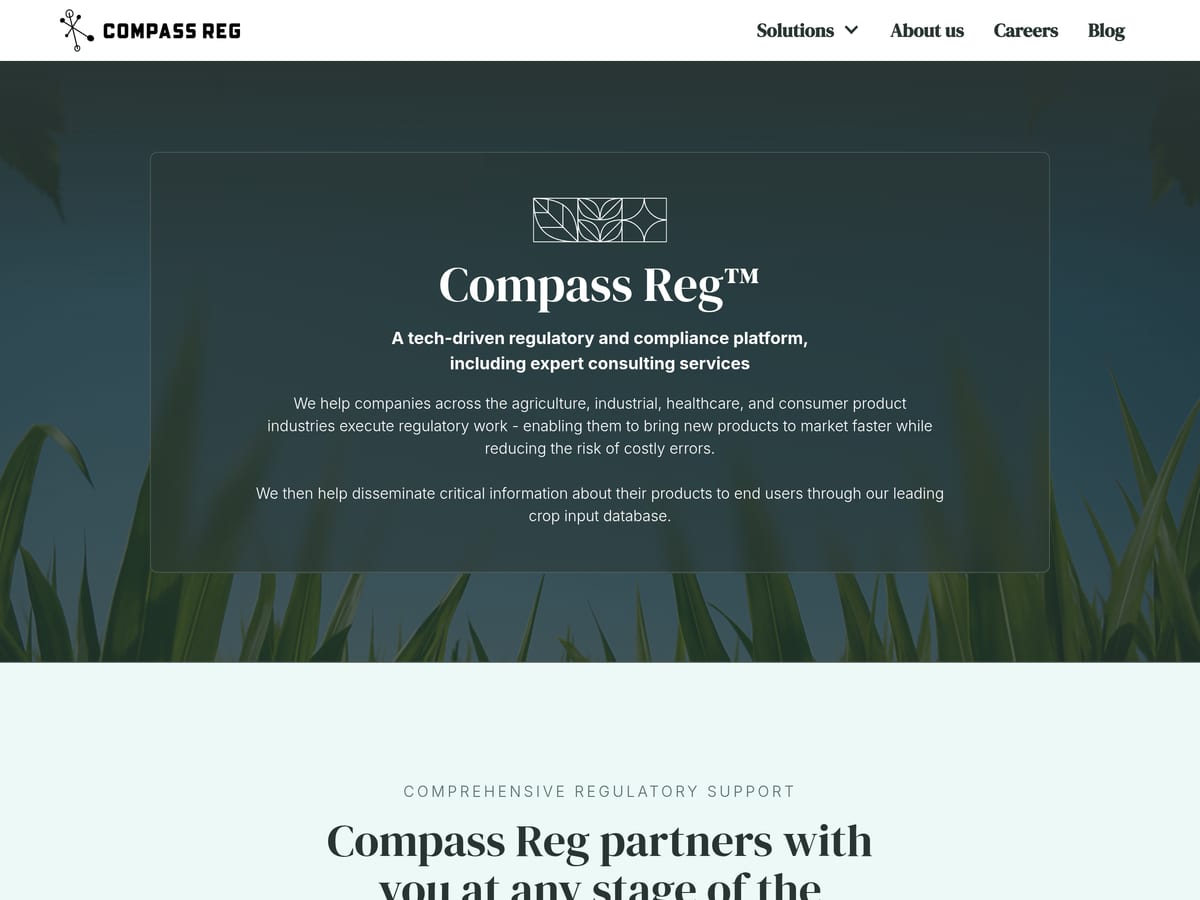
Compass Regulatory, known to its buyers as Compass Reg, set out in 2023 to do something the agricultural crop-input industry had not really seen before. It paired hands-on regulatory expertise with a purpose-built software platform and a trusted crop input database. The company helps pesticide, fertilizer, plant growth regulator, and biological product companies navigate the tangle of EPA, USDA, FDA, and state requirements, get products to market faster, and avoid the kind of compliance error that can cost a season or a launch. For a five-person, unfunded team led by a CEO, a CFO, and a small bench of veteran regulatory specialists, the product story was compelling. The visibility story was not.
When a regulatory affairs manager at a crop input manufacturer sits down to solve a FIFRA registration problem or figure out state tonnage reporting, they search. They search for the specific statute, the specific product class, the specific state. And in early 2024, when they searched, Compass Regulatory was almost nowhere to be found. The category the company was defining, modern software for agricultural regulatory compliance, had barely any established search demand, and the little demand that did exist was being intercepted by decades-old consultancies with far stronger domains and years of accumulated authority.
That is the position Compass Reg was in when it engaged WithBestLinks. The mandate was not to chase traffic that did not yet exist. It was to build genuine search authority in a highly technical, trust-driven vertical, so that the company's solutions pages, the ones targeting terms like agricultural regulatory compliance software and crop input database, would be positioned to rank against incumbents who had a fifteen-year head start once the category matured. This is the account of how we laid that foundation over eight months, and why manual editorial outreach was the right instrument for a category that was still being invented.
Selling trust software to the most risk-averse buyers
Agricultural regulatory affairs is one of the highest-trust B2B verticals we work in. The buyer is a compliance professional whose entire job is to reduce risk, and the cost of a wrong vendor decision is not an awkward renewal conversation. It is a rejected dossier, a missed registration window, or a product pulled from shelves. That buyer does not convert off a clever landing page. They convert off signals of credibility, and in organic search, credibility is spelled out in the authority of the domains that reference you and the company you keep on the results page.
Compass Reg started with almost none of that. As a company founded in 2023 and publicly announced as a venture in early 2024, its domain had a very short history, a thin backlink profile, and a Domain Rating of 4. Meanwhile the search results for its money terms were dominated by established consultancies, the traditional FIFRA and biopesticide registration firms that have serviced this market for years. Those competitors were not necessarily better at content. They simply had the accumulated link equity that Google reads as trust, and no amount of on-page optimization closes that gap on its own.
There was a second, subtler problem. The company had no dedicated blog, resource library, or guides. Its footprint was almost entirely product and solutions pages: Regulatory Services, Regulatory Software, Crop Input Database, and an About page. That is a perfectly reasonable choice for an early-stage team focused on product, but it meant there were very few pages for high-authority publications to naturally reference, and very few topical entry points for search engines to understand what the company was expert in. We were building link authority toward a site that gave the outside world little to link to.
Finally, the subject matter itself raised the bar on outreach. You cannot earn a placement in a serious agricultural trade publication by pitching generic filler. Editors in this space, and the regulatory professionals who read them, can smell a writer who does not know the difference between a biostimulant and a biofertilizer, or who thinks EPA registration and state registration are the same step. Every angle we pitched had to be technically correct and genuinely useful, or it would be rejected on sight. That constraint shaped the entire program, from how we staffed drafts to how we chose which publications to approach in the first place.
Starting from a Domain Rating of 4
Before we pitched a single editor, we ran a full baseline audit so that every decision downstream was anchored to a number rather than a hunch. The picture it produced was exactly what you would expect from a strong product with almost no earned authority behind it. The site was technically sound and clearly written, but it was effectively invisible for the terms that mattered, and its link profile was too thin to compete. We wanted a hard record of where the company stood on the day we started, so that eight months later the gains would be defensible rather than anecdotal.
The audit also confirmed that the small pool of existing referring domains was mostly incidental: startup directories, a couple of industry association listings, and social profiles. Useful for confirming the company exists, but not the kind of editorial, in-context links from respected publications that build authority in a trust-heavy vertical. There was no toxic-link cleanup to do, which was a small mercy, but there was also very little foundation to build on. One of the few genuinely relevant signals was the company's BPIA membership, a marker of standing among biological product regulatory specialists that we could later reinforce with editorial coverage.
We benchmarked every signal against the median of the three most visible incumbent consultancies ranking for Compass Reg's target terms. The gap was wide but, importantly, it was a gap of authority rather than a gap of relevance. Compass Reg was more topically focused and more modern than most of the field. That told us an editorial link program could close the distance over time, because we were not trying to make an irrelevant site relevant. We were trying to make a relevant site trusted, which is a far more tractable problem and one that earned links solve directly.
| Signal | At kickoff | Benchmark |
|---|---|---|
| Domain Rating | 4 | 38 (incumbent median) |
| Referring domains | 10 | 210+ |
| Editorial (in-content) links | 3 | 140+ |
| Organic keywords ranking | ~2 | 300+ |
| Pages targeting money terms | 4 | 20+ |
Betting on earned editorial links over volume
Our thesis was simple to state and hard to execute. In a vertical this technical and this trust-driven, the most defensible path to future organic visibility is manual, editorially earned links from publications the buyer already respects, supported by just enough new linkable content to give those links somewhere credible to point. We did not buy links, we did not chase volume for its own sake, and we did not pitch anything we could not stand behind on the merits. Every part of the plan bent toward one goal: making a young domain read as a trusted authority to both editors and search engines.
We also made an early call to treat Compass Reg's thin content footprint as an opportunity rather than a liability. Because the site had few pages, each new asset we helped shape could be purpose-built to be both linkable and rankable, mapped directly to a money term. That kept the program tight. Every link we earned pointed at a page that was itself designed to convert a regulatory professional, not at a stray blog post that would never see a demo request. The discipline of a small page set became a strategic advantage rather than a gap to paper over.
The whole engagement ran on a short list of concrete, repeatable moves, executed every week and measured against the baseline.
- Built a topical map tying each money term (agricultural regulatory compliance software, crop input database, EPA pesticide registration, state product registration) to a specific target page.
- Shaped a small set of genuinely linkable reference assets: explainer-grade pages on FIFRA workflow, state registration and tonnage reporting, and biological product categories, so editors had something authoritative to cite.
- Prospected publications by audience fit first, domain rating second: agricultural trade press, crop protection and input-industry outlets, ag-tech and precision-ag media, and regulatory and compliance publications.
- Wrote every pitch around a technically correct, timely angle (PFAS in crop inputs, bilingual labeling, biologicals registration complexity) rather than a generic product mention.
- Ran fully manual, personalized outreach to named editors and contributors, with subject-matter review on every draft before it left the building.
- Secured contextual, in-content links with descriptive anchors pointing at the mapped money pages, avoiding over-optimized exact-match anchors.
- Tracked Domain Rating, referring domains, and keyword coverage against the kickoff baseline every two weeks and reallocated effort toward the angles that were landing.
The publications we earned regulatory placements on
Execution is where an editorial program in a technical vertical either earns its keep or falls apart, and the difference is almost entirely in the pitching. We did not send templated mass emails. Each outreach thread started from a specific editor and a specific angle we believed their readers would genuinely value. Because the Compass Reg team gave us access to real regulatory expertise, we could pitch, for example, a plain-language breakdown of how PFAS scrutiny is reshaping crop-input formulation reviews, or why bilingual labeling requirements are becoming a compliance flashpoint. Those are angles a trade editor wants, because their audience is living those problems right now.
We prioritized publications by how closely their readership matched Compass Reg's actual buyers, then by domain authority. A placement in a respected crop-protection trade outlet read by regulatory and product-registration teams was worth more to this company than a higher-DR link on a general business site, because the contextual relevance told search engines exactly what Compass Reg was authoritative about. Every draft went through subject-matter review before submission, which is why our acceptance rate stayed high and why we never had a placement questioned on accuracy. In a field where a single misstatement about FIFRA can undo a reputation, that review step was not overhead. It was the product.
Over eight months the program earned 22 editorial, in-content links across four broad publication types. We deliberately spread anchors and target pages so the profile looked earned, because it was, rather than engineered. The table below shows how the placements broke down and the kinds of angles that earned them.
| Publication type | Links placed | Avg. DR | Example angle |
|---|---|---|---|
| Agricultural trade & crop-protection press | 7 | 58 | How EPA and state registration timelines actually differ |
| Ag-tech & precision-ag media | 6 | 54 | Why crop-input data quality breaks FMIS platforms |
| Regulatory & compliance publications | 5 | 63 | Managing FIFRA renewals and tonnage reporting at scale |
| Sustainability & biologicals outlets | 4 | 49 | The registration maze for biopesticides and biostimulants |
- Domain Rating410
- Referring domains1041
- Editorial in-content links325
Domain Rating climbing from 4 toward 14
Eight months in, the numbers moved the way a foundational authority program should in a niche with little existing search demand: slowly and steadily, because you are building trust from a near-standing start rather than harvesting demand that already exists. Domain Rating rose from 4 to 10, and touched 14 at its peak mid-program before settling into the low double digits as the profile matured. Referring domains grew from a low base to a modest but genuinely editorial set, and the share of those that were in-content links, the ones that actually carry trust, went from almost none to the clear majority of the profile. That shift in composition matters as much as the raw count, because a profile weighted toward earned placements is exactly what a trust-heavy vertical rewards.
It is worth being honest about what this phase was and was not. In a specialised regulatory niche, there is very little existing search demand to convert, so the goal for the first year was never traffic. It was standing. Compass Reg now has a small, credible footprint of organic keywords, six at last measurement, where before it had almost none, and every one of those early rankings sits on the money pages rather than on vanity phrases. The category is still forming, and the point of this work was to be positioned to rank as that demand arrives, not to manufacture visits that the market is not yet searching for.
The most important outcome, though, is one that shows up in the sales conversation rather than any analytics dashboard. Regulatory professionals who had never heard of a 2023-founded startup were now encountering Compass Reg in editorial pieces in publications they already read and trusted. That kind of credible, third-party exposure is what shortens the trust curve for an early-stage vendor in a risk-averse market, and it is exactly what a thin, unlinked domain cannot manufacture on its own. The authority we built is the asset that will let those money pages rank as the category matures.
None of this required inflating the content footprint into a sprawling blog. The program stayed disciplined: a small number of genuinely useful reference pages, a modest number of genuinely earned links pointing at the pages that convert. That is the version of SEO that compounds, because every editorial placement keeps working long after it is published and keeps sending both link equity and qualified readers. A year from now, those 22 placements will still be doing their job, which is the opposite of what happens when the spend stops on a paid program.
Why authority beats content volume in regulatory search
It worked because the tactic matched the vertical. In a market where the buyer's whole job is reducing risk, trust is the ranking factor that matters, and trust is built through authority, not volume. Editorial links from publications this audience already respects do double duty: they teach search engines that Compass Reg is a credible authority on agricultural regulatory compliance, and they put the brand in front of qualified readers in a context where credibility is assumed rather than argued. No amount of on-page tuning substitutes for that, and no amount of blog output shortcuts it.
It also worked because we respected the subject matter. Every angle was technically correct and genuinely useful, which is what kept editors saying yes and kept the company's name attached only to work it could stand behind. That discipline is not optional in regulatory affairs. A single sloppy placement that misstated how FIFRA or state registration works would have cost more credibility than ten good ones earned. By pairing outreach craft with Compass Reg's real expertise, spanning pesticides, fertilizers, plant growth regulators, and biological products, we built a link profile that looks exactly like what it is: a serious company being cited by serious publications.
Finally, it worked because the program was honest about the stage. We were not chasing traffic in a category that does not yet generate much of it. We were building authority toward a handful of pages designed to convert regulatory and product-registration teams, and we measured everything against a real baseline so effort always flowed to the angles that were landing. That is the difference between SEO as a vanity exercise and SEO as a durable asset, and in a category Compass Reg is still helping to define, it is the difference that gives a five-person team a credible base to grow from as the market catches up.
Yes, and arguably it matters more for you than for an incumbent. A new domain has almost no earned trust, which is precisely the signal search engines use to rank trust-driven B2B queries. Editorial links are the most defensible way to build that trust before the demand arrives. Compass Reg started at a Domain Rating of 4 and reached 10 in eight months, peaking at 14, which is the foundation that lets a young domain start ranking as its category matures.
It works better when it is technical. Editors in specialized fields reject generic pitches instantly, so accuracy is an advantage, not a constraint. We put every angle and draft through subject-matter review, drawing on your team's expertise, so placements are correct and genuinely useful. That is why our acceptance rate stayed high and no placement was ever questioned on accuracy.
No. We treated a thin content footprint as an advantage. Rather than a sprawling blog, we shaped a small number of purpose-built reference pages mapped directly to your money terms, then earned links pointing at those pages. The result compounds without the overhead of publishing constant filler that never converts a buyer.
By pointing everything at commercial reality. We map every link to a specific money page and prioritize publications by how closely their readership matches your real buyers, not just by domain rating. In an early category, the honest goal is authority and standing, not traffic, so we build the credibility that will let those pages rank as demand grows rather than chasing visits the market is not yet searching for.
In a niche with little existing demand, authority builds steadily rather than overnight, and the first year is about foundation rather than traffic. For Compass Reg, Domain Rating climbed from 4 to 10 over eight months. The editorial links are earned, in-content placements on real publications, so they keep working and keep building trust long after they go live, unlike paid placements that vanish when you stop paying.
“We were building a category before there was search demand to capture, and most agencies wanted to churn out blog posts and hope. WithBestLinks did the unglamorous work: they learned FIFRA, they learned what a biopesticide registration actually involves, and then they earned us links on publications our buyers already trust. Eight months in, we finally have real authority behind our name when a regulatory lead goes looking for the exact problem we solve.”
Want results like Compass Regulatory?
Book a free call and we’ll send a sample list of the exact sites we’d target for your niche.
Book a callMore case studies
How Software Finder Scaled Past Incumbent Review Sites With Editorial Link Building
A multi-year editorial link-building program helped Software Finder climb from Domain Rating 66 to 74 and grow organic traffic roughly 490%, from about 5,800 visits a month in 2023 to a peak near 66,000, now sustaining around 34,000 a month across 13,000+ ranking keywords.
View case study
How Okara Turned an Invisible Launch Into a Category-Defining Organic Channel
A young AI marketing product went from a Domain Rating of 3 and about 25 organic visits a month to a DR of 64 and thousands of monthly visitors in nine months of manual, high-authority link building.
View case study
Building Editorial Authority for a Craftsmanship-Driven Software Agency
How WithBestLinks lifted Coding Crafts from a Domain Rating of 9 to 26 over eight months of manual editorial outreach, building the off-page authority a craftsmanship-driven software agency needed to compete for high-intent development buyers.
View case study